
Pastor or Leader,
Most churches already know they are losing young people.

You see it in youth rooms that used to be full. You feel it when college students do not return home from campus. You notice it in the widening gap between who shows up on Sunday and who stays connected during the week.
The challenge is not awareness. The challenge is assumption.
Many churches assume that keeping young people is far more complicated than it actually is. There is a quiet belief that retention requires larger budgets, trendier services, or a constant stream of events. Some leaders feel pressure to compete with culture or to reinvent the Gospel itself. Over time, this belief creates exhaustion before meaningful change even begins.
What is often missed is something much simpler.
Young people do not leave because the church lacks truth. They leave because they lack consistent connection.

This is personal for me.
In my hometown of Spartanburg, South Carolina, there has been an average of one shooting per day at the time of this writing. Violence is no longer something young people hear about occasionally. It is something they live around, walk past, and carry with them emotionally. In moments like these, the work of the church is not abstract. It is urgent.
Scripture tells us that faith comes by hearing the Word of God. But an honest question must be asked. What happens when there is no hearing? What happens when young people are no longer close enough to the church to hear the Word spoken clearly, consistently, and personally into their lives?
Gen Z and college students are not closed off to faith. Many are deeply open to conversations about justice, purpose, hope, and belonging. What they respond to most is not hype or production. They respond to presence. Being noticed. Being followed up with. Being remembered beyond Sunday.
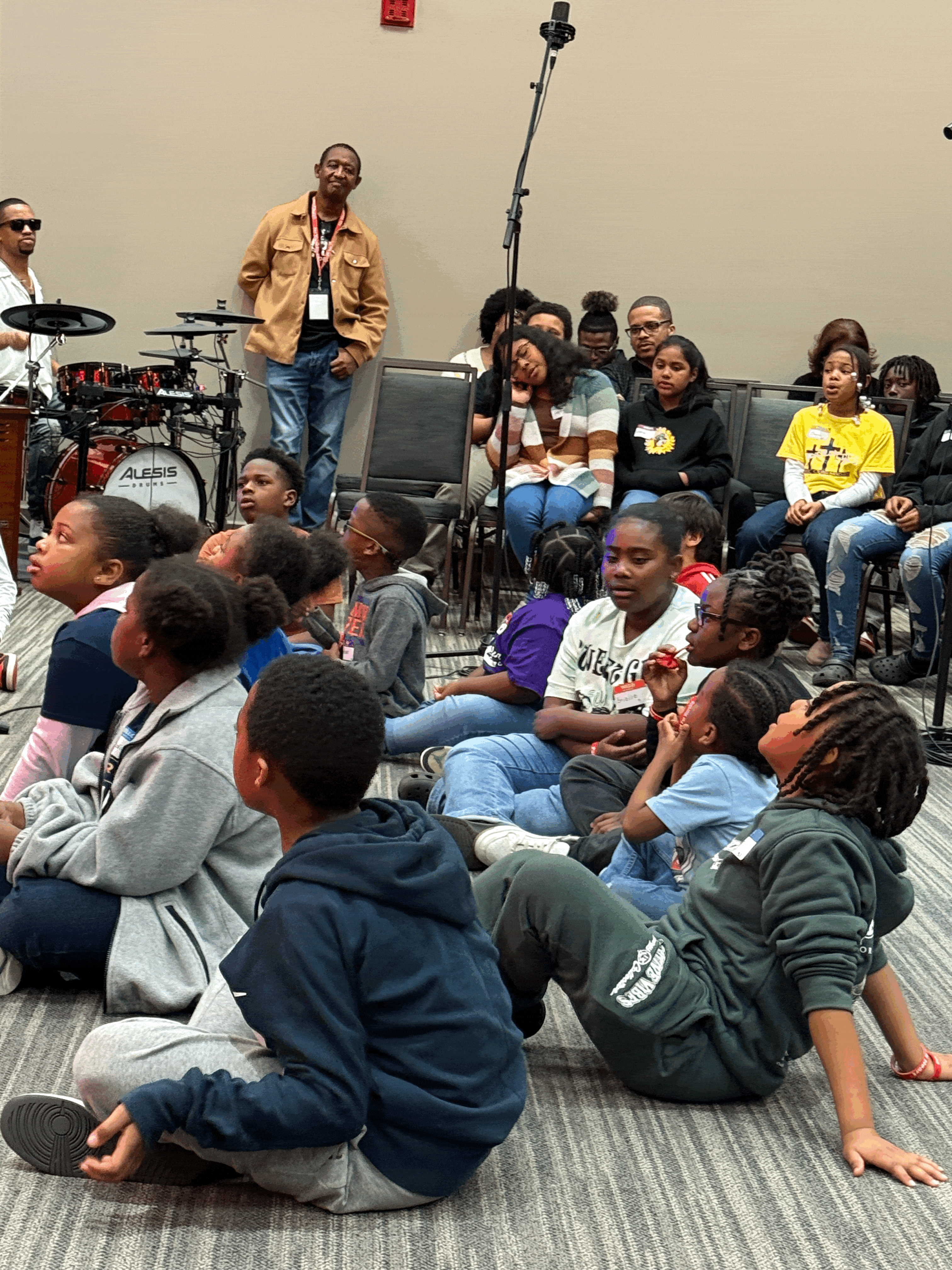
Right now, those needs are being met elsewhere. Digital spaces provide daily touchpoints. Online communities offer consistent engagement. Content adapts quickly to language, context, and season of life.
Meanwhile, many churches are trying to do the same work manually. Staff are limited. Volunteers are stretched thin. Systems were designed for a different era and are now carrying expectations they were never built to sustain.
This is where conversations about AI often become misunderstood.
AI is not a magic fix for ministry. It does not replace discipleship. It does not replace relationships. It does not replace prayer, pastoral care, or the work of the Holy Spirit.
What it can do is support consistency.
When guided wisely, AI can help churches maintain connection, personalize follow up, support volunteers, and extend ministry beyond the building without adding more hours or increasing burnout. But this only works when leadership provides clarity, intention, and theological grounding.
AI still needs agents. It still needs people who understand ministry and are willing to steward tools faithfully rather than chase trends.
The churches seeing fruit today have not abandoned tradition. They have simply recognized that keeping young people is not about doing more. It is about doing a few things consistently and doing them well.

That is why I am opening a conversation this month about how churches can use AI to support youth and college ministry in practical and faithful ways while preserving the Gospel, the human touch, and spiritual integrity.
There is no hype here and no pressure. Only clarity and direction.
As you consider the year ahead, it is worth asking a simple question. If faith comes by hearing, what systems are in place to make sure the next generation is still hearing the Word at all?
Grace and peace,
